Is 2026 a Good Year to Start a Business?
Absolutely. Despite economic uncertainty, new business applications have been at record highs. The digital economy continues to create opportunities that did not exist even five years ago. The barriers to entry have never been lower — you can launch a global business from your laptop with minimal investment.
The Complete Business Launch Checklist
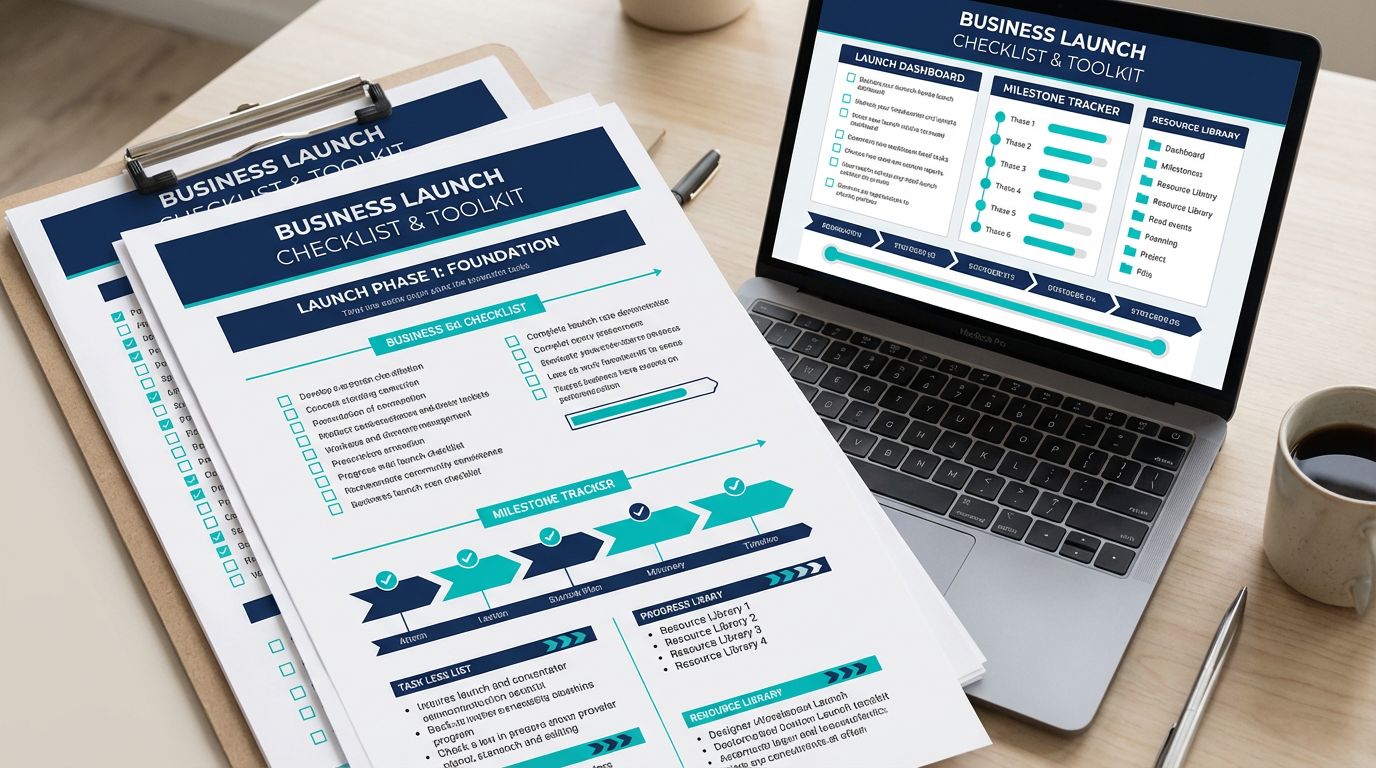
Business Launch Checklist & Toolkit
Step-by-step launch checklist with 200+ action items, timelines, and resource guides.
Phase 1: Validate Your Idea (Week 1-2)
Before you invest time and money, prove that people actually want what you are building:
- Define the problem you solve: What pain point does your product or service address?
- Identify your target customer: Who specifically has this problem? Be as specific as possible.
- Research the competition: Who else solves this problem? What do they charge? Where do they fall short?
- Talk to potential customers: Have 10-20 conversations with real people in your target market. Ask about their pain points — do not pitch your solution yet.
- Validate willingness to pay: Would they pay for a solution? How much? What is their current workaround?
Phase 2: Plan Your Business (Week 2-3)
- Write a lean business plan: One page covering problem, solution, target market, revenue model, and key milestones.
- Define your business model: How will you make money? (Product sales, subscriptions, services, commissions)
- Set financial goals: Revenue targets for months 1, 3, 6, and 12.
- Calculate startup costs: List everything you need to spend before earning revenue.
- Determine your funding source: Self-funded, loans, investors, or crowdfunding?
Phase 3: Legal Setup (Week 3-4)
- Choose a business structure: LLC (most common for small businesses), Corporation, or Sole Proprietorship.
- Register your business name: Check availability in your state and register.
- Get an EIN: Apply for a free Employer Identification Number from the IRS.
- Open a business bank account: Keep personal and business finances separate from day one.
- Get necessary licenses and permits: Requirements vary by industry and location.
- Consider business insurance: General liability at minimum, professional liability if offering services.
Phase 4: Build Your Brand (Week 4-5)
- Choose your brand name: Memorable, easy to spell, domain available.
- Register your domain name: Secure your .com as soon as possible.
- Design your logo and visual identity: Colors, fonts, and design elements that reflect your brand personality.
- Create brand guidelines: Document your visual standards for consistency.
- Set up social media profiles: Claim your name on relevant platforms, even if you do not plan to use them immediately.
Phase 5: Build Your Product or Service (Week 5-8)
- Create your minimum viable product (MVP): The simplest version that delivers value.
- Set up your website: Professional, mobile-friendly, and optimized for search engines.
- Set up payment processing: Stripe, PayPal, or similar for accepting online payments.
- Create your pricing structure: Research competitors and test different price points.
- Set up your delivery system: How will customers receive your product or service?
Phase 6: Prepare for Launch (Week 8-10)
- Set up email marketing: Choose a platform (MailerLite, ConvertKit) and create a welcome sequence.
- Create launch content: Blog posts, social media posts, and email announcements.
- Build a launch list: Collect emails from interested people before you launch.
- Set up analytics: Google Analytics and Search Console to track performance.
- Test everything: Go through the entire customer journey yourself. Place a test order.
Phase 7: Launch Day
- Announce to your email list
- Post across social media
- Tell friends, family, and professional network
- Monitor for issues: Watch for bugs, payment problems, or customer confusion.
Phase 8: Post-Launch Growth
- Collect customer feedback: Ask every customer what they think and what could be improved.
- Start content marketing: Publish weekly blog posts targeting your key SEO terms.
- Build partnerships: Collaborate with complementary businesses.
- Iterate on your product: Use customer feedback to improve continuously.
- Track your metrics: Revenue, traffic, conversion rate, customer acquisition cost.
Common Mistakes First-Time Entrepreneurs Make
- Waiting for perfection: Launch with an MVP and improve based on real feedback.
- Spending too much upfront: Keep costs minimal until you have proven revenue.
- Ignoring marketing: Build it and they will come is a myth. Plan your marketing before launch.
- Not talking to customers: Your assumptions about what customers want are usually wrong. Validate everything.
- Doing everything alone: Know when to delegate, outsource, or ask for help.
Get the Complete Toolkit
Free: Business Launch Checklist
50 essential steps to launch your business. Get it free.
Our Business Launch Checklist & Toolkit expands this list to 50 detailed items with worksheets, templates, and guides for each phase. Everything you need to go from idea to launch in one organized package.
FAQ
How much money do I need to start a business?
It depends on the type of business. Online businesses can start for under $500. Service businesses for under $2,000. Product businesses vary widely based on inventory and manufacturing costs.
How long does it take to start a business?
You can launch a simple online business in 2-4 weeks. More complex businesses may take 2-6 months to set up properly.
Do I need a business plan?
Yes, but it does not need to be a 30-page document. A one-page lean plan is enough to start. Expand it when seeking funding.