What Is a Sales Funnel?
A sales funnel is the journey a potential customer takes from first discovering your business to making a purchase. It is called a funnel because at each stage, some people drop off — your job is to minimize that drop-off and maximize conversions.
The 4 Stages of a Sales Funnel
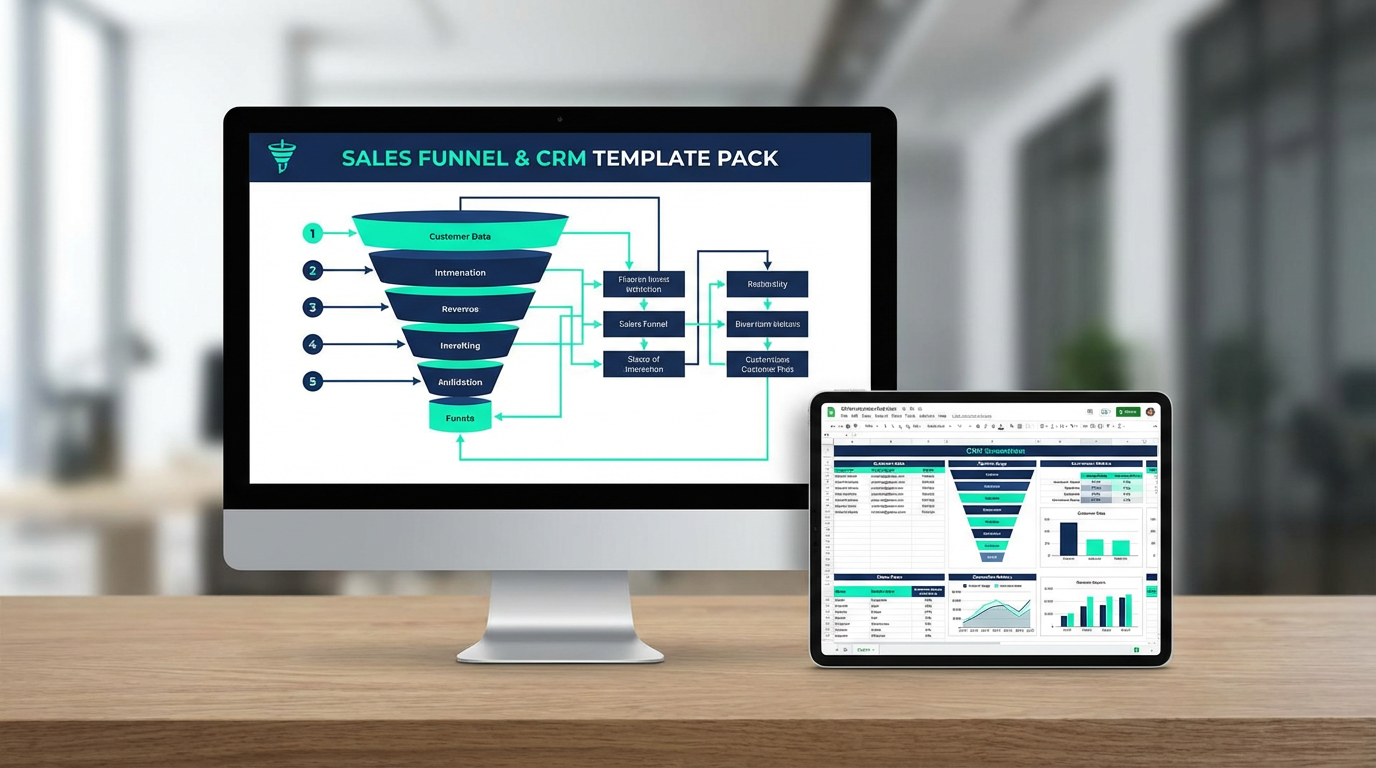
Sales Funnel & CRM Template Pack
Visual sales funnel builders, lead tracking sheets, and pipeline management dashboards.
Stage 1: Awareness (Top of Funnel)
This is where potential customers first learn about you. They have a problem and are starting to look for solutions.
How they find you:
- Google search (SEO and blog content)
- Social media posts
- Paid advertising
- Word of mouth and referrals
- Guest posts and podcast appearances
Your goal: Capture their attention and provide value. Do not sell yet.
Content types: Blog posts, social media content, free guides, videos, infographics.
Stage 2: Interest (Middle of Funnel)
They know you exist and are curious. They are evaluating whether you can help them.
How to nurture interest:
- Email newsletter with valuable tips
- Case studies showing results
- Webinars and workshops
- Detailed product comparisons
- Free trials or samples
Your goal: Build trust and demonstrate expertise.
Stage 3: Decision (Bottom of Funnel)
They are ready to buy but choosing between you and alternatives.
How to win the decision:
- Clear product benefits and features
- Customer testimonials and reviews
- Money-back guarantees
- Limited-time offers or bonuses
- Comparison pages showing your advantages
Your goal: Remove objections and make buying easy.
Stage 4: Action (Purchase)
The moment of conversion. Make the buying process frictionless.
How to optimize:
- Simple checkout process (minimize steps)
- Multiple payment options
- Clear pricing with no hidden fees
- Mobile-optimized purchase flow
- Immediate confirmation and delivery
Building Your Sales Funnel: Step by Step
Step 1: Map Your Customer Journey
Document every touchpoint from first contact to purchase:
- Where do they first hear about you?
- What makes them want to learn more?
- What information do they need before buying?
- What objections do they have?
- What triggers the final purchase decision?
Step 2: Create a Lead Magnet
A lead magnet is a free resource that captures email addresses. It should be:
- Directly relevant to your paid product
- Immediately useful (solves a quick problem)
- Easy to consume (checklist, template, short guide)
- High perceived value
Step 3: Build an Email Sequence
After someone downloads your lead magnet:
- Email 1 (Day 0): Deliver the lead magnet and introduce yourself
- Email 2 (Day 2): Share a relevant tip or case study
- Email 3 (Day 4): Address a common objection
- Email 4 (Day 6): Share a testimonial or success story
- Email 5 (Day 8): Present your offer with a clear CTA
Step 4: Optimize Your Sales Page
Your sales page needs:
- Compelling headline addressing the core pain point
- Benefits-focused copy (not just features)
- Social proof (testimonials, numbers, logos)
- Clear pricing and what is included
- Strong call-to-action button
- FAQ section addressing objections
Key Metrics to Track
Free: Business Launch Checklist
50 essential steps to launch your business. Get it free.
| Metric | What It Tells You | Good Benchmark |
|---|---|---|
| Website visitors | Awareness reach | Growing monthly |
| Email opt-in rate | Lead magnet effectiveness | 2-5% of visitors |
| Email open rate | Subject line and sender trust | 20-30% |
| Click-through rate | Email content relevance | 2-5% |
| Conversion rate | Sales page effectiveness | 1-3% of visitors |
Common Funnel Mistakes
- No lead magnet: Asking for a sale before building trust
- Too many steps: Every extra step loses 10-20% of prospects
- Weak follow-up: Most sales happen after 5-7 touchpoints
- Ignoring analytics: Not tracking where people drop off
- One-size-fits-all: Not segmenting leads by interest or behavior
Get Started with Professional Templates
Our Sales Funnel & CRM Template Pack includes funnel mapping worksheets, email sequence templates, sales page frameworks, and CRM setup guides to build a converting funnel from day one.
FAQ
How long should a sales funnel be?
It depends on your price point. Low-cost products ($10-50) can have short funnels. High-ticket items ($500+) need longer nurture sequences.
Do I need expensive software for a sales funnel?
No. You can start with free tools: a website, a free email platform (MailerLite), and a payment processor (Stripe).
What is a good conversion rate for a sales funnel?
Industry average is 2-5% from lead to customer. Top performers achieve 5-10%.